

Archivio della Società romana di storia patria vol. 147/II (2024) 12 – PICCIONI
6,00€
Codice DOI: 10.61019/ASRSP_147_II_12
File formato PDF
Lidia Piccioni
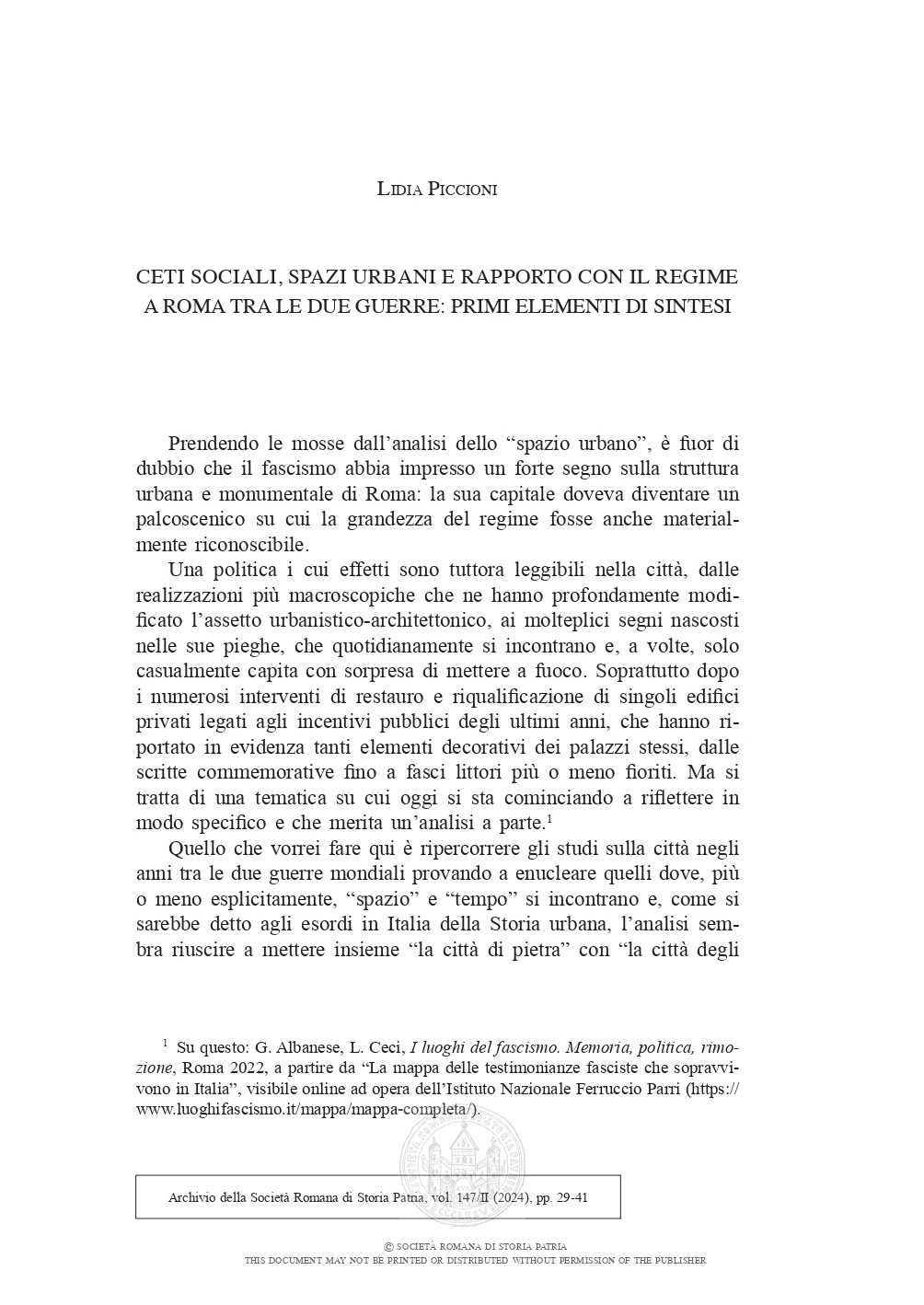
Ceti sociali, spazi urbani e rapporto con il regime a Roma tra le due guerre: primi elementi di sintesi
Il saggio intende ripercorrere i principali studi sulla storia di Roma tra le due guerre mondiali mettendo in evidenza le analisi che privilegiano una lettura delle trasformazioni della sua società in rapporto con le trasformazioni dello spazio urbano. Particolare attenzione è dedicata al tema delle nuove periferie e dei diversi ceti che le abitano, dalla “Roma borghese” dei dipendenti pubblici e delle classi dirigenti del regime, fino alle borgate ufficiali volute dal regime stesso tutto intorno alla città e destinate alle fasce più marginali; dove forma e struttura dell’abitare divengono specchio delle diverse condizioni di status della popolazione ma anche osservatorio privilegiato del rapporto tra questa e il fascismo. Il quadro storiografico che ne emerge – a lungo limitato ma in via di arricchimento – racconta dunque di una città segnata da crescenti polarizzazioni sociali. E di un progetto del fascismo per la sua capitale che le rinforza e pianifica nel quadro di una politica del “consenso” articolata. Di un paesaggio urbano da un lato monumentalizzato e modernizzato, dall’altro sempre più diviso, la cui osservazione consente un confronto tra progettazione “dall’alto” e ricezione “dal basso”. E che alla fine sarà ulteriormente evidenziato e messo alla prova dall’e- mergenza estrema della guerra.
Social classes, urban spaces, and the relationship with the Fascist Regime in Rome between the wars: preliminary elements of synthesis
This essay revisits key studies on the history of Rome between the two World Wars, focusing on analyses that interpret the transformations of Roman society in relation to changes in urban spaces. Particular focus is given to the subject of the new suburbs and the diverse social groups that inhabit them, ranging from the upper-class Roma and public employees to the ruling classes of the Fascist regime, and the working-class settlements (borgate) established by the regime around the city for the most marginalised members of society. The form and structure of the housing in these spaces reflects the different social statuses of the population, and also serves as a privileged vantage point from which to examine the relationship between society and Fascism. The resulting historiographical picture, which was once limited but is now becoming increasingly enriched, por- trays a city characterised by growing social polarisation and a Fascist project for its capital that reinforced and planned these divisions as part of a complex policy of ‘consensus’. This was a cityscape that, on the one hand, was monumentalised and modernised, and, on the other, was increasingly divided. Observing this enables a comparison to be made between top-down planning and bottom-up reception. Ultimately, this landscape would be further highlighted and put to the test by the severe crisis of war.
luglio 2025, pp. 13